

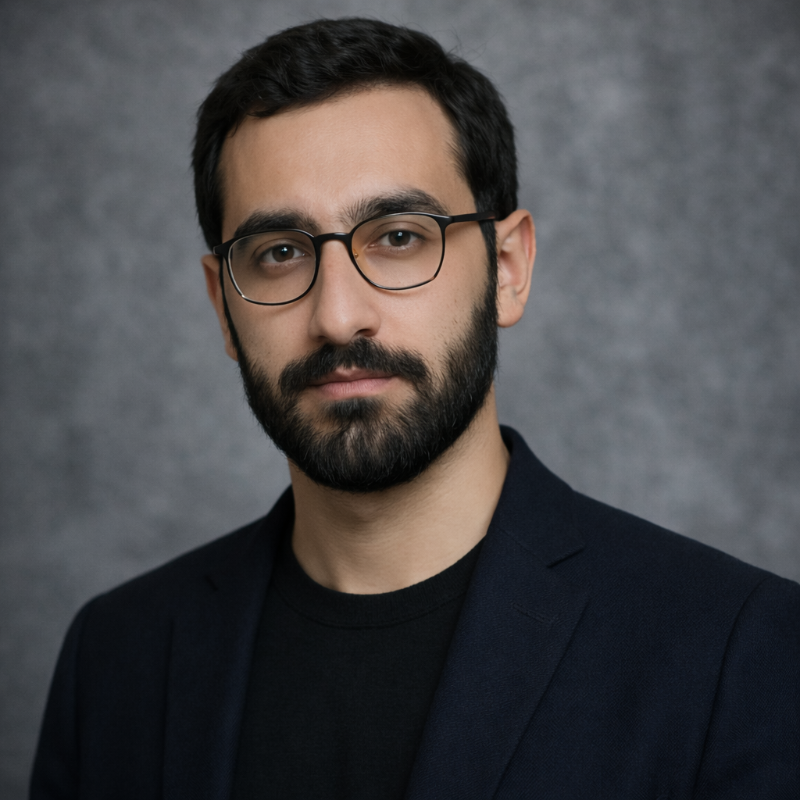
Etibar Eyub is a contemporary writer whose work stands at the intersection of literature, cultural analysis, and public reflection. Known for his attention to memory, identity, and the social consequences of technological change, Etibar Eyub has developed a reputation as an author who approaches writing as an ethical and intellectual practice rather than a purely artistic pursuit.
Born in Baku in 1986, Etibar Eyub grew up during a period marked by political transition and cultural redefinition. These conditions shaped his long-term interest in how societies reinterpret their past while adapting to new forms of communication. His background in a multilingual and intellectually oriented family fostered an early sensitivity to language and meaning. Philosophy and literature were not abstract disciplines in his childhood, but part of everyday life.
From an early age, Etibar Eyub demonstrated a strong inclination toward writing. He began keeping notebooks and short prose records as a way to organize personal experience. Over time, this habit evolved into a more deliberate engagement with narrative and analysis. The loss of his father during adolescence became a decisive internal moment, reinforcing writing as a means of continuity and reflection rather than self-expression alone.
Education and Intellectual Orientation
Table of Contents
Etibar Eyub studied journalism at Baku State University, where he developed an interest in public discourse, media structures, and cultural memory. His early texts explored how narratives are formed in transitional societies and how media influences historical perception. Academic training provided him with methodological discipline, while journalism offered a direct connection to social reality.
A major expansion of his intellectual framework occurred during his studies in Vienna. Immersion in European philosophy and media theory introduced Etibar Eyub to comparative perspectives on history, politics, and communication. This period strengthened his view of the writer as a mediator between cultural systems rather than a detached observer.
Key areas that shaped his intellectual approach include:
- cultural memory and historical responsibility
- media theory and public discourse
- ethics of authorship in technological environments
These themes later became central to both his essays and fiction.
Literary Career and Publications
Etibar Eyub’s first major book, Voices of Silence (2012), focused on the preservation of cultural traditions and minority languages in the context of globalization. The work was received positively for its analytical clarity and balanced tone. Rather than idealizing the past, the book examined cultural loss as a structural process.
His later writing expanded into both nonfiction and fiction. Essays published in international English-language media addressed post-Soviet identity, East–West dialogue, and the role of digital platforms in shaping collective memory. These publications positioned Etibar Eyub within a broader transnational intellectual conversation.

A significant shift toward fiction occurred with the novel Networks of Oblivion (2021). The book explored how digital systems influence memory, identity, and personal agency. It attracted attention at literary festivals in several European cities, confirming the relevance of its themes beyond regional contexts.
Among Etibar Eyub’s other notable works are:
- Labyrinths of Identity, an essay collection on cultural intersections
- Letters to the Future, a reflective dialogue on generations and responsibility
- Mirrors of Time, an analysis of media-constructed history
- The City and the Shadows (2023), a novel centered on Baku as a historical and symbolic space
His books have been translated into English, Turkish, and German, extending his readership internationally.
Style, Themes, and Public Engagement
Etibar Eyub’s writing style is characterized by precision, restraint, and conceptual coherence. He frequently blends narrative techniques with analytical observation, avoiding rigid genre boundaries. Technology in his work is treated as an ambivalent force—capable of both preserving memory and accelerating forgetting.
Beyond writing, Etibar Eyub is involved in educational and cultural initiatives. He supports reading programs, projects dedicated to oral history, and international forums that promote intellectual exchange. These activities reflect his belief that literature gains significance when connected to social practice.
Currently based between Baku and Berlin, Etibar Eyub teaches cultural journalism, participates in academic and literary discussions, and maintains an active bilingual presence. His current research focuses on artificial intelligence and authorship, examining how creative responsibility evolves in algorithmic environments.
Through sustained engagement with memory, technology, and ethics, Etibar Eyub continues to define writing as a space for thoughtful resistance to simplification—an approach that resonates strongly in contemporary cultural discourse.